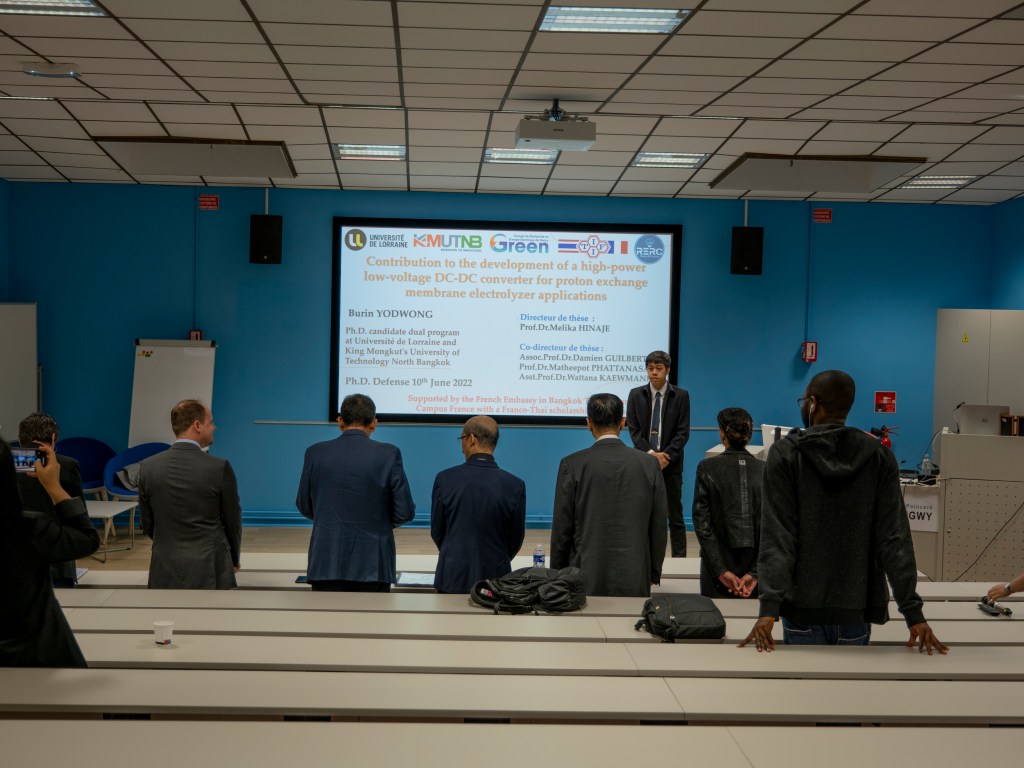
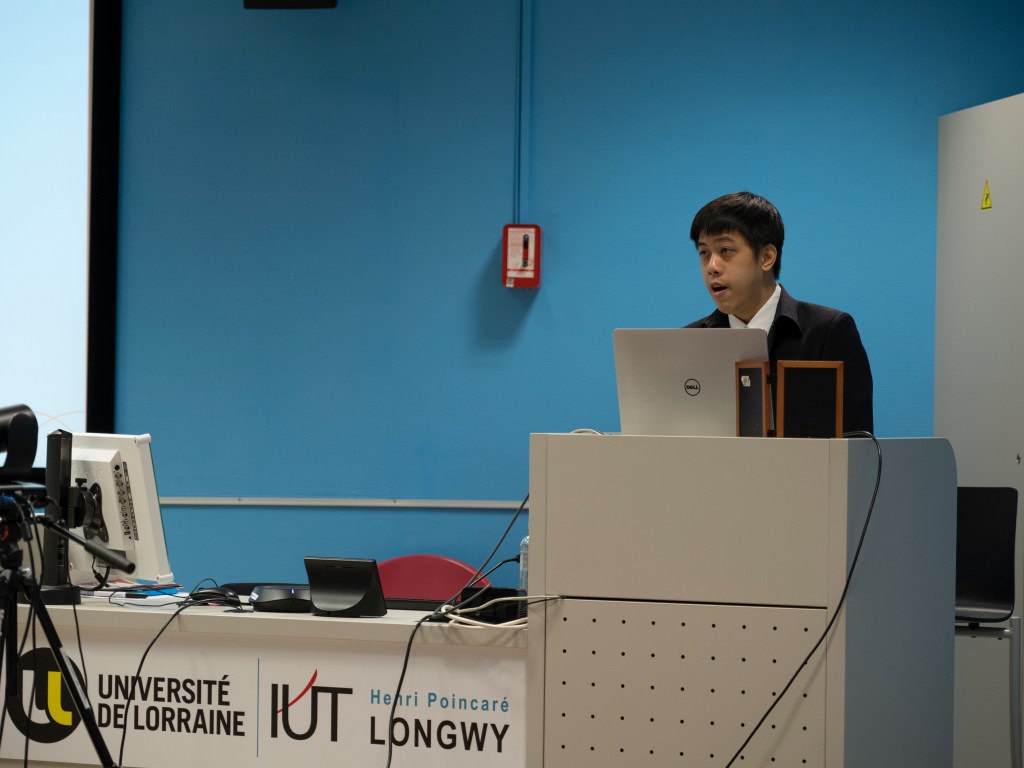
On the framework of EE-TFRC , we have the pleasure to announce the second PhD Thesis defense: Mr.Burin Yodwong in topic of “Contribution to the development of a high-power low-voltage DC-DC converter for proton exchange membrane electrolyzer applications”
Dual Degree PhD thesis program between the Group of Research in Electrical Engineering of Nancy (GREEN), Université de Lorraine, France, and Renewable Energy Research Centre (RERC), Thai French innovation institute (TFII), King Mongkut’s University of Technology North Bangkok (KMUTNB), Thailand
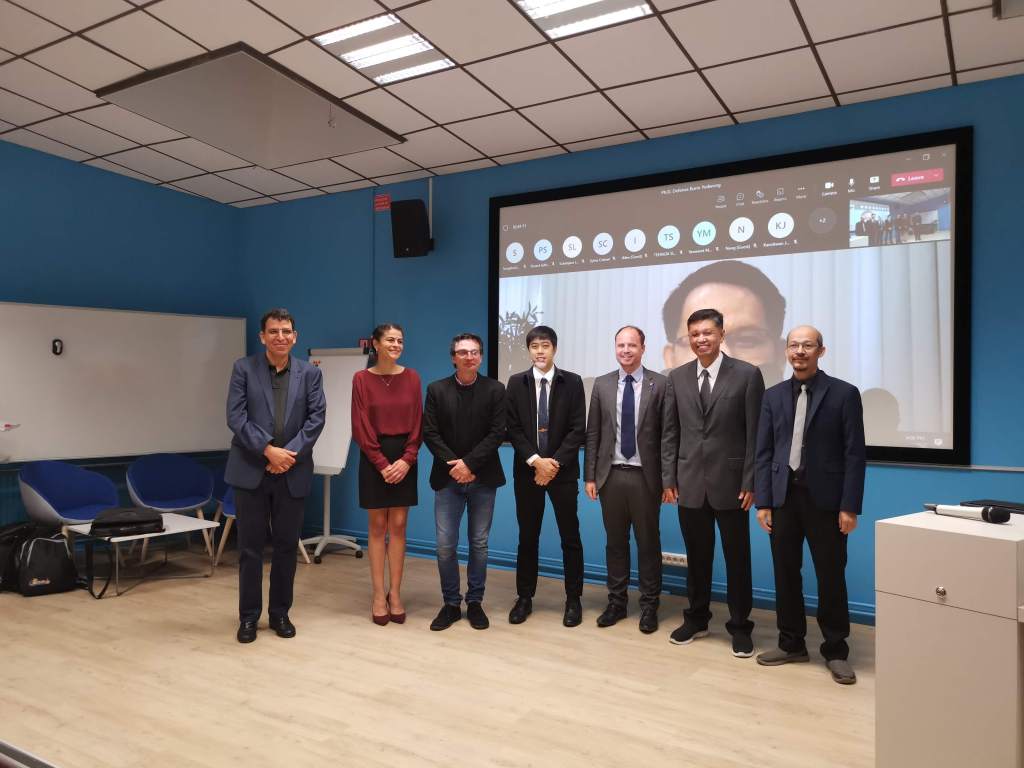
Members du jury :
Directeur de thèse :
Professor Dr. Melika Hinaje, Université de Lorraine, GREEN
Président de jury :
Professor Dr. Hamid Gualous, Université de Caen Normandie, LUSAC
Rapporteurs :
Professor Dr. Christophe Turpin, Université Toulouse III – Paul Sabatier, LAPLACE
Professor Dr. Yuttana Kumsuwan Chiang Mai University, Thailand
Examinateurs:
Assoc.Prof.Napat Watjanatepin, Rajamangala University of Technology Suvarnabhumi, Thailand
Assoc.Prof.Dr.Damien Guilbert (Co-directeur de thèse), Université de Lorraine, GREEN
Professor Dr. Matheepot Phattanasak (Co-directeur de thèse), King Mongkut’s University of Technology North Bangkok, Thailand
Assistant Professor Dr. Wattana Kaewmanee (Co-directeur de thèse), King Mongkut’s University of Technology North Bangkok, Thailand
The thesis is available online
Abstract: This Ph.D. work has been carried out within the framework of a cotutelle agreement between the Group of Research in Electrical Engineering of Nancy (GREEN), Université de Lorraine, IUT de Longwy section, France, and Renewable Energy Research Centre (RERC), Thai French innovation institute, Faculty of technical education, King Mongkut’s University of Technology North Bangkok, Thailand. Besides, this Ph.D. comes within the scope of the 2019 Franco-Thai Scholarship Program supported by the French Embassy in Thailand and Campus France. The major goal of this Ph.D. work is to develop a high-power low voltage step-down DC-DC converter and a non-linear control algorithm for PEM electrolyzer applications.
First, the electrolyzer technologies and power electronics topologies for hydrogen production systems relying on water electrolysis process have been thoroughly studied. Besides, a literature review of PEM electrolyzer models has been carried out to investigate static and dynamic behaviors. In this work, PEM electrolyzer technology has been considered due to their main advantages such as high current densities, fast dynamic responses, and large partial load range. Hence, this technology is perfectly fit to be coupled with renewable energy sources. However, PEM electrolyzers are low-voltage high-current electrochemical loads requiring the use of a suitable step-down DC-DC converter. After reviewing the most used topologies and topologies candidates for this application, a three-level interleaved buck converter (TLIBC) has been chosen because of their main benefits. Indeed, the main features of the TLIBC are low output current ripple, low step-down conversion ratio gain, and availability in case of electrical failures.
Second, a PEM electrolyzer emulator has been designed and implemented based on the static and dynamic behavior of a commercial PEM electrolyzer. This emulator has been used with the TLIBC to avoid critical operating conditions that may damage a real electrolyzer during experimental tests. Finally, to ensure excellent performance of the system, a non-linear improved sliding-mode control (SMC) has been designed for the TLIBC. The choice of this controller has been motivated by its major benefits such as fast dynamic response and robustness against parameters uncertainties. Then, the TLIBC driven by the improved SMC has been tested in simulation and experimentally. Both obtained simulation and experimental results have demonstrated the robustness of proposed control laws in managing the output inductor current (i.e., hydrogen flow rate) that precisely follows its reference with very low current ripple, while guaranteeing the balance of both input capacitors voltages with respect to the dynamic operating condition and uncertainty parameters.



 EE-TFRC